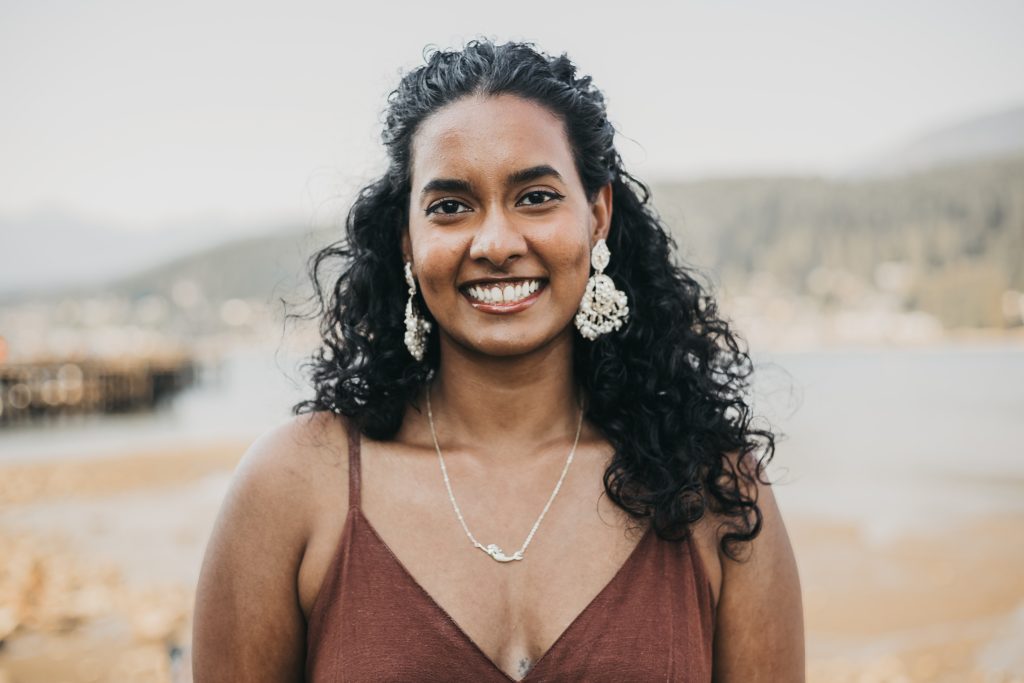
We sat down with Joefin Peter to discuss the lack of representation of BIPOC providers in sexual and reproductive health. Joefin emphasizes the importance of culturally specific care for racialized individuals and highlights how initiatives like the BIPOC Maternal Professionals Database are helping make this care more accessible.
The following is a transcript of a conversation between Joefin Peter and Hannah Yaghmaei, a project coordinator at DiversiPro. Some sections have been condensed for clarity.
Could you introduce yourself and the work you do?
I am a sexual health educator based in British Columbia, certified through Options for Sexual Health BC. I’m also a reproductive spectrum doula, trained by Doula School Canada. I’m applying to grad school as well, hoping to research reproductive violence and its impact on new parents.
Currently, I run an organization called Oru Kutty Community (OKC). We focus on sexual health education and reproductive health services. Many of my clients are immigrants, and when you immigrate to Canada sometimes you’re so alone and isolated. As you navigate things like sexuality and reproduction, these feelings of loneliness are often magnified. OKC aims to provide education, support, and comfort.
Could you tell me a bit about the lack of representation of BIPOC (Black, Indigenous, and People of Colour) individuals working in these roles?
The sexual and reproductive health spaces are both very white-women dominated, and there’s a lot of racism that happens by accident or on purpose. There’s a huge lack of BIPOC individuals working in these spaces, so the reason I started OKC was because we need sexual and reproductive health for us, by us. If you take a look at the breadth of research, it’s clear that we need language-specific services available. I am personally focusing on working with brown and black individuals. South Asian women face a lot of racism — black and brown bodies are still oppressed. That’s why I do a lot of my content in Tamil, and what I post in English is usually about intersectionality.
You recently spoke at the launch of the BIPOC Maternal Professionals Database. Could you share what this initiative is?
The BIPOC Maternal Professionals Database is the first of its kind in Canada and it’s a resource that connects new moms to culturally-appropriate health professionals. It was launched by the Mesh of Mothers Foundation, which is run by Millicent Asiedu. She’s a mom who wanted to bridge the gaps in Alberta’s healthcare system for mothers, especially African Canadian mothers, during COVID. Mesh of Mothers does a lot of programming that looks like support groups. They also have lots of resources for families and have people checking in and providing social support to mothers.
The BIPOC database also really benefits care providers because it’s free for us to join. Usually, with any sort of database or directory, there’s a financial barrier to it since you have to buy into their membership. So right away, there’s that difference in accessibility, which I really appreciated because even though I have a lot of community experience, I’m an early-career professional and I’m not in a place where I can pay for multiple memberships.
Why do you think culturally specific care is so important?
Without culturally specific care, clients have to do a lot of explaining in order for their maternal support providers to make sense of their situation. Providers who aren’t familiar with their clients’ culture might question or invalidate their experiences. Even though I’m not walking in the exact shoes of the person I am working with, I have similar shoes with the same kind of holes.
I also think there’s an inherent safety that comes with BIPOC providers engaging with BIPOC clients. I say that very carefully because I’m also aware that within-group racism exists. In COVID, anti-Asian racism was at an all-time high. Right now, Indian racism is at an all-time high. We all go through the bouts of that, but to have something like the BIPOC database and work on it, and perfect it as time goes on, is making me very hopeful for the future.
How do you see resources like the BIPOC Maternal Professionals Database benefitting BIPOC communities?
From an intersectional lens, when people need reproductive healthcare, they often also have other things to worry about, for example, immigration or refugee status. Having a BIPOC database makes it easier to find culturally-appropriate professionals. By focusing on and targeting one audience, even if it’s a collective one, the database helps reach people that aren’t the typical target demographic. It also reaches people who might need more support than your average person. We need more things like this that are catered to us specifically.
Unfortunately, we, as people who are BIPOC running these kinds of organizations, have a really hard time getting sponsorships and partnerships right now. Funding for initiatives like this is sparse. Most of us are doing this out of our own pocket and on our own dime because our society doesn’t like to talk about sexual health and reproduction, so our society doesn’t prioritize funding for programming like this. That’s why I’m so glad that Millicent has found funding for Mesh of Mothers. Also, the Canadian government’s Department for Women and Gender Equality (WAGE) is expected to face budget cuts of 80%, so there are organizations across Canada that have had to shut down, specifically sexual and reproductive health ones. There’s a reason for why I’m really talking about stuff like this right now. America’s been so loud about what they’re doing, but even here in Canada it seems like the rug is being pulled from under our feet quietly so that nobody notices.