
Every so often, a book, film, or conversation stays with me long after it ends. Not because I agree with everything it says, but because it forces me to confront difficult questions. That was my experience watching the film 2073.
So many headlines today are about political polarization, misinformation, social division, climate instability, and the rapid rise of artificial intelligence. We encounter these stories so frequently that they can begin to feel disconnected from one another.
2073 refuses to let that happen. The film weaves these trends together into a disturbing vision of a future shaped by authoritarianism, surveillance, inequality, and democratic decline. While the story is fictional, what makes it unsettling is how much of it feels familiar.
As someone who has spent much of my career helping organizations build more inclusive workplaces and communities, I found myself asking an unexpected question: What if diversity, equity, and inclusion work is about far more than workplace culture? What if it is also one of the ways we strengthen the social fabric that democracy depends upon?
The more I reflected on the film, the more convinced I became that inclusion, belonging, and trust may not simply be organizational priorities. They may be essential democratic skills.
The film 2073 imagines a dystopian future shaped by authoritarianism, AI surveillance, climate collapse, inequality, disinformation, and democratic erosion. Granted, it is speculative, but the film’s power comes from how closely it reflects current real-world events and trends already visible in many countries.
I must admit that the film disturbed me. But watching it also triggered an insight: diversity, equity, and inclusion (DEI) can play a significant role in interrupting the imagined future of a fractured world it portrays. Perhaps that is ultimately why authoritarian leaders fear it.
The public discussion that the film has sparked is not simply because it presents a bleak dystopian future – a necessary wake-up call – but because it feels unsettlingly plausible. Supporters describe the film as urgent, politically courageous, and frightening.
Critics, however, argue that the film overwhelms viewers with despair and catastrophic imagery – you see people dying or dead in real news footage. Some reviewers called it “doomscrolling” and “fear porn” for its relentless pessimism.
Regardless of which side you are on, the film presents a difficult truth: dystopias rarely arrive overnight. They emerge gradually through polarization, institutional distrust, economic exclusion, fear-based politics, and the normalization of dehumanization.
There are striking parallels between the film 2073 and the book You Can’t Do Business with Hitler, written by Douglas Miller and published in 1941 before the full horrors of the Holocaust were understood. Miller, an American diplomat stationed in Germany, argued that authoritarianism was not merely a political difference or a temporary instability — it fundamentally reshaped society, institutions, economics, morality, and human relationships.
Similarly, 2073 is structured as a warning before catastrophe fully arrives. The film suggests that democratic erosion, surveillance, disinformation, climate destabilization, and rising authoritarian tendencies are already underway, even if many people still perceive them as isolated issues rather than interconnected systemic threats. As I watched the film, I was reminded of what is happening in the United States, China, Turkey, India, Russia, North Korea, and Hungary under former Prime Minister Viktor Orban.
Even though the book and the film were created more than eighty years apart and in very different historical contexts, both works function as warnings about the dangers of normalizing authoritarianism before its full consequences become undeniable.
In both works, the core message is: The danger is not only the endpoint. The danger is the gradual normalization along the way.
For leaders working in diversity, equity, and inclusion, 2073 raises an important question: What role can inclusion play in preventing the social fragmentation that makes these futures possible?
The answer may be far larger than most organizations realize.
For years, DEI work has often been framed too narrowly — as compliance, representation targets, workplace culture, or reputational management. While these areas matter, they represent only part of the larger picture.
At its core, inclusion is about how societies decide who belongs, whose voices matter, and who has access to power, safety, opportunity, and dignity.
Those are not merely organizational concerns. They must be democratic concerns.
When institutions fail to create equitable access and meaningful participation, distrust deepens. People begin to feel invisible, unheard, and excluded from the systems shaping their lives. I have seen this in the DEI organizational audits we do, where low levels of trust among employees on our Trust Index leads to cynicism, fear, disengagement, performative compliance, and failed DEI initiatives.
Inclusive societies and organizations, by contrast, build resilience because they foster participation rather than alienation. Organizations with high levels of trust are generally more resilient during periods of disruption and uncertainty.
One of the recurring themes in 2073 is the erosion of social cohesion. Communities become fractured, isolated, and suspicious of one another. This is not simply a fictional device used in the film; it mirrors what researchers, political scientists, and social psychologists have observed.
A long-forgotten report from 2002 on social cohesion by Canada’s Department of Justice and Canadian Heritage found that “people need the capacity to participate in their community; this requires institutions — but the institutions may need to adapt to changes. Beyond formal institutions, we need to understand positive new forms of participation. Who participates? Who are leaders in engaging others? What encourages participation?”
Equity work done well can increase social cohesion and interrupt the dark trends warned about in the film 2073. It helps organizations and communities to, among other things, build cross-cultural understanding, reduce stereotypes and misinformation, create psychologically safer environments, and foster relationships across difference. In other words: build more cohesive and resilient teams.
The future imagined in 2073 is shaped by widening inequality. History consistently shows that societies marked by extreme inequities become more vulnerable to instability, unrest, and democratic decline. People will seek certainty and protection in rigid identities and simplified narratives, which leads to scapegoating, conspiracy thinking, and hostility toward groups perceived as the “other.”
Equity work addresses structural barriers – in employment, healthcare, housing, education, etc. – that limit access to opportunity and participation. Organizations and governments that ignore these realities may unintentionally contribute to broader social fragmentation. Investing in equitable systems helps strengthen social trust — both internally and externally.
Films like 2073 resonate because they force audiences to confront uncomfortable possibilities about where society may be heading. But they also invite reflection on the choices still available to us.
The opposite of dystopia is not perfection.
It is participation. It is accountability. It is shared humanity. It is the ongoing work of ensuring that people are not pushed to the margins of social, economic, and democratic life.
We too often make “perfection” the enemy of the “good”. Sometimes doing “good work” is enough.
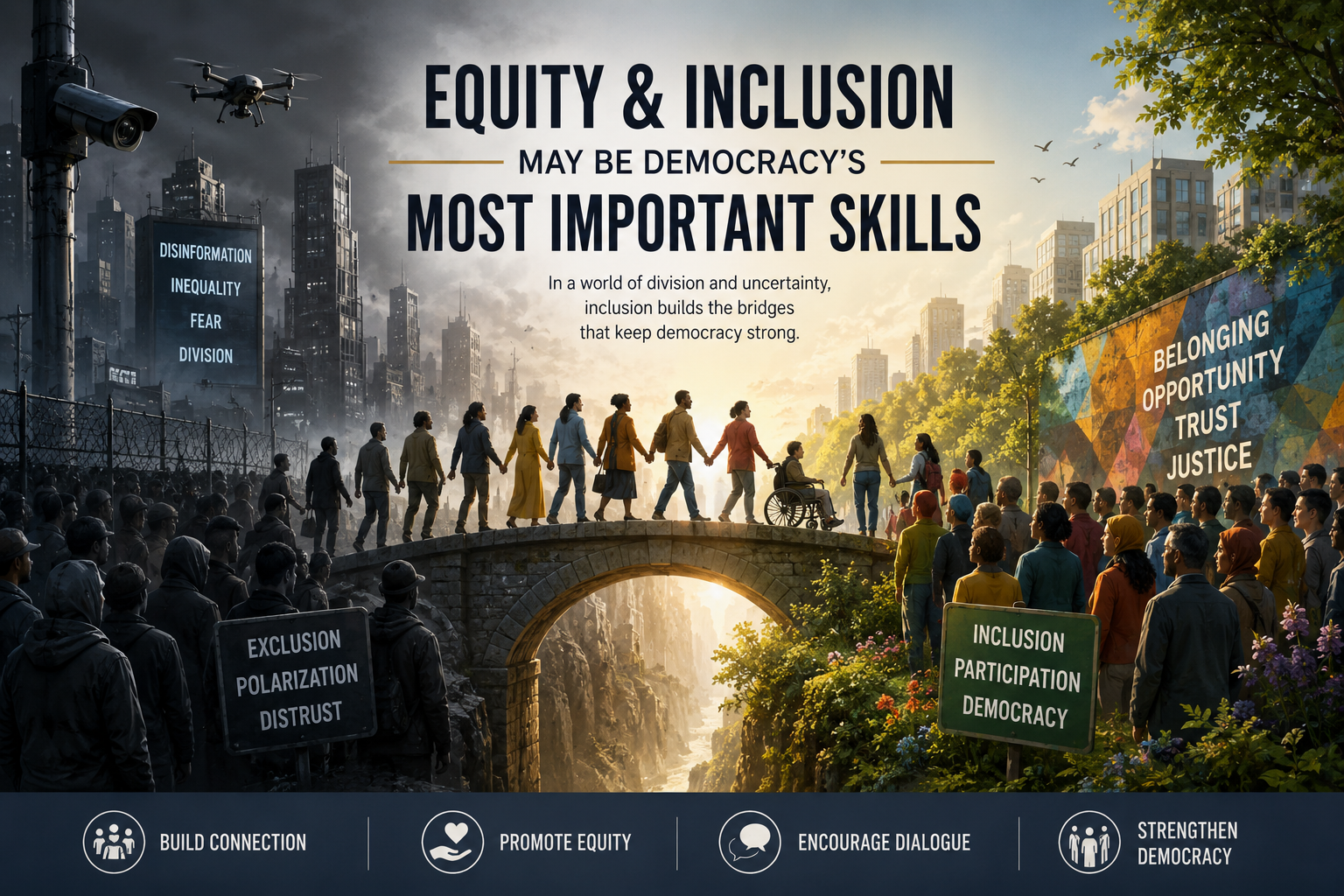
At its best, diversity, equity, and inclusion work is not about optics or ideology. It is about creating the conditions under which pluralistic societies can remain resilient, humane, and democratic in times of profound change.
These are not “soft skills.” They are necessary skills for hard times that may ultimately make DEI not simply an organizational strategy, but one of the defining civic responsibilities of our time.