For some time now, I have made it my mission to support connections between people, particularly those from different cultures. Yet, the more time I spend doing this, the humbler I become.
A week ago, while talking with friends, I initially stated that I respect and am open to all religions, but then went on to explain how the rituals in them made no sense to me and to question their relevance to one’s spiritual journey.
I later came to realize that I was not practicing what I teach and that my interpretation of these rituals was just one of many. It both frustrates and liberates me to repeatedly realize this kind of shortcoming. Hardly a week goes by in which I don’t catch – and surprise – myself passing judgment on other cultures. And each time I step back and observe my own limited thought process, I feel a small victory.
I have learned that being interculturally competent does not mean one stops making judgments about aspects of other cultures that do not seem moral and ethical, or even appropriate, to us. But it means that such judgments should not be made SOLELY by considering how a particular cultural practice of another group is perceived in our own culture.
Yet, it’s tough to connect beyond cultural differences for at least two reasons. First, we are intimately defined by our culture. It inhabits our very soul and defines how we see ourselves. As American anthropologist Edward T. Hall wrote, “Culture is man’s medium. There is not one aspect of human life that is not touched and altered by culture. This means personality, how people express themselves, the way they think, how they move, how problems are solved…” ¹
Second, to understand another group (or person) is to understand and accept the way their minds work, to see things from their points of view, and to appreciate that their cultural background and/or experience has influenced their beliefs and judgments. It is essential to recognize that their view is just as valid as our own. This is not easy. In fact, it is extraordinarily difficult. It requires a high degree of self-consciousness. It involves a process of going deep into one’s values and beliefs, and recognizing that we have built-in blinders, hidden and unstated assumptions that influence our perspective. With respect to my own views about religion, I came to realize that I felt superior in that I believed that I did not need to embrace rituals and looked down upon those who did.
Research shows that we generally think we are better at seeing and respecting others and their differences than we really are, because we underestimate how much our cultural background influences us. So long as a cultural difference is not too different or does not call into question our views, say, about feminism, social justice, or the like, we can be open. It is when we are confronted with the very different that we start believing we must make choices, qualify our support, ignore or reject.
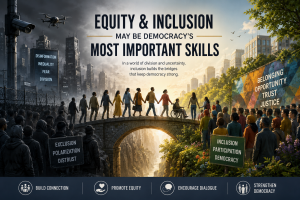
It is for this reason that, in the important work of Diversity, Equity and Inclusion, simply saying that people are different and that cultures are unique, and that we must all respect each other’s differences, can be a hollow cliché. Tolerance is often misconstrued as openness. My experience in talking with groups about these issues is that we all want one thing above everything else, and that is to be seen, heard and valued for who we are. Unfortunately, this common and burning desire does not naturally lead to a willingness to see, hear and value another person or group.
Understanding ourselves and understanding others are closely related processes. Anthropologists and other experts (such as M. Bennett², M. Hammer³, U. Brinkmann and O. van Weerdenburg⁴) have developed useful models to help us understand ourselves and thus become able to bridge cultural differences. They all point in one direction: one cannot interpret any aspect of a culture apart from, and without the cooperation of, the members of that culture.
It is therefore through curiosity, genuine interest and dialogue that we can discover the validity of other people’s cultures and of their differences. On my way to learn more about religious rituals…
──────────────────
¹ Edward T. Hall, Beyond Culture, 1976, Random House, page 16.
² Milton J. Bennett, Ph.D., Becoming interculturally Competent. In J.S. Wurzel (Ed.) Toward multiculturalism: A reader in multicultural education, Newton, MA: Intercultural Resource Corporation, 2004
³ Mitchell R. Hammer, The Intercultural Development Inventory, A New Frontier in Assessment and Development of Intercultural Competence. In M. Vande Berg, R.M. Paige, & K.H. Lou (Eds), Student Learning Abroad (Ch. 5, pp 115-136), Sterling, VA: Stylus Publishing
⁴ Ursula Brinkmann and Oscar van Weerdenburg, Intercultural Readiness, Four Competences for Working Across Cultures, Palgrave and Macmillan, 2014