
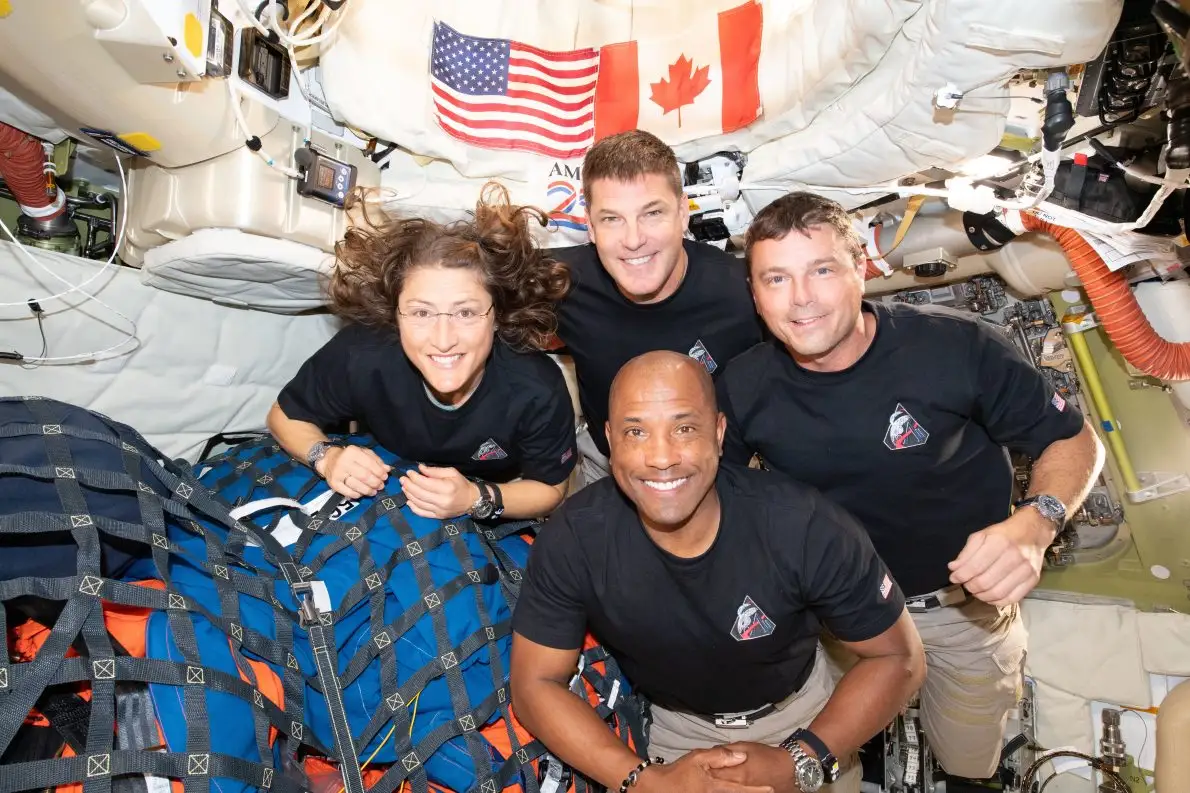
 The Artemis II crew – (clockwise from left) Mission Specialist Christina Koch, Mission Specialist Jeremy Hansen, Commander Reid Wiseman, and Pilot Victor Glover inside the Orion spacecraft on their way home. (Image Credit: NASA Image and Video Library, Photo ID art002e013365)
Full disclosure: I’m a bit of a space and science fiction nerd. I enjoy reading about space and an imagined future where humans discover ourselves by meeting beings from other worlds. So it’s no surprise that I, along with millions of other television viewers, watched with amazement and nervous anticipation as the crew of Artemis II blasted off on a column of fire and smoke on its way to the moon.
As a young boy in 1969, I watched grainy black and white images on television as Neil Armstrong stepped on the surface of the moon.
 I still have a preserved copy – wrapped in plastic – of the Life magazine issue that featured the moon landing. And I have watched every episode (and movie) of Star Trek – multiple times.
At its core, Star Trek wasn’t really about space, or “going where no (one) has gone before.” It was about who we become when we choose to work across difference.
Long before “diversity, equity, and inclusion (DEI)” became part of organizational language, Star Trek the series imagined a future where those principles were not aspirational, they were reality. But Star Trek didn’t pretend equity and inclusion were easy. Episodes frequently explored cultural misunderstandings, power imbalances between species, and ethical dilemmas where “fairness” was contested.
For me one of the most memorable and provocative episodes of the Star Trek series is the episode that introduces two alien characters from the same planet. At first glance, they appear identical except for one striking detail: one is black on the left side and white on the right. The other is white on the left side and black on the right. This is the only difference between them. And yet, they are locked in a lifelong, violent hatred.
It remains one of the clearest allegories for racism, and one that still resonates deeply for me in conversations about inclusion, diversity, equity, and anti-racism today.
The crew of Artemis II represents a deliberate move toward broader inclusion: Victor Glover — first Black astronaut on a lunar mission; Christina Koch — first woman on a lunar mission; Jeremy Hansen — first Canadian and non-American to travel to the moon; Reid Wiseman — mission commander emphasizing team cohesion.
These are very smart people. Their accomplishments are breathtaking. They would also have been excellent representatives of the human race if they had bumped into an alien spaceship parked on the dark side of the moon.
Four very different persons, each bringing their own strengths to the team, making it stronger. You could see it every time they spoke. Although Glover stressed that his historic role as the first Black astronaut to travel to the moon is part of a broader “human history,” rather than solely a milestone based on race, his presence and his race should not be ignored. And neither should the gender of Koch.
Competence matters. Difference and inclusion matter. You can’t build a strong team by ignoring any of the three.
Hansen, the Canadian, said, “This is a mission for humanity, not just one nation”, a reminder that inclusion expands ownership and belonging. And Wiseman, as a counterpoint to the geopolitical tensions between Canada and the USA said, “Our strength comes from our different perspectives and experiences.” Which, for me, was a clear statement that diversity only creates value when it is integrated into decision-making to do great and difficult things.
What this means for organizational leaders is that successful DEI initiatives are not accidental. They’re the result of systems that have been intentionally reframed and reworked. Inclusion requires shared decision-making, valuing different perspectives, and embedding equity into processes, not just values. And equity occurs when organizations consistently produce inclusive outcomes across hiring, leadership, and culture.
I was struck by what Hansen had to say about taking risks during his conversation with Prime Minister Mark Carney. He emphasized that space exploration requires a balance of calculated risk, deep collaboration, and a willingness to learn from failure.
“Risk is necessary but calculated, well-thought-out risk, and risk that you balance with others. People will point out when you are over your skis,” he said. “So, you have to be smart about how you take risks.” As a country and a team, he said, “we have to be willing to have some failures and be okay with that but ultimately knowing that we are going to persist and win in the final calculation.”
It’s a lesson that anyone who wants to do the difficult work of creating diverse, inclusive and equitable workplaces should keep in mind.
The Artemis II mission was more than sending humans the farthest distance away from earth, more than a scientific milestone. It’s a demonstration of what it looks like to operationalize diversity, equity, and inclusion at the highest level of performance.
I salute the crew of Artemis II. In the iconic Vulcan greeting, may they “live long and prosper”.