
If your organization is feeling the tension around DEI right now, don’t mistake it as a reason to pause or, worse, to quit. That tension is a sign the system is being stretched. And in that discomfort, real transformation is possible…. So, what will you do? Will you retreat or reimagine? Will you perform or transform? Will you protect your comfort, or practice courage?
~~
Written by Mareisha N. Winters, 2025
We all witnessed the wave of public commitments to diversity, equity, and inclusion (DEI) in 2020 after the murder of George Floyd, and how those commitments faded in the years following. DEI language disappeared from websites. DEI roles were quietly restructured. Budgets were reduced or eliminated. And when asked what’s going on, leaders often say things like: “We’re focusing on the basics.” “We need to regroup.” Or “We don’t have time.”
Fast forward to 2025, and the rollback is happening at lightning speed, fueled in large part by the Trump administration’s Herculean efforts to eliminate DEI. They’ve labeled it divisive, declared an end to “illegal DEI discrimination,” and weaponized the myth of meritocracy to justify rolling back equity efforts. And while some organizations are giving in to the administration’s demands out of fear, I also wonder if some are using it as a convenient off-ramp from work they never truly valued in the first place.
Contrary to popular belief, DEI resistance isn’t always loud or aggressive, as we’ve witnessed since Trump took office for his second term. More often, it’s subtle. It often hides behind professionalism, neutrality, or a “strategic pause.” It shows up in the discomfort of leadership, the absence of follow-through, or the over-reliance on performative gestures. The result is a slow, self-reinforcing cycle that chips away at trust, credibility, and momentum.
This resistance isn’t just personal or political, it’s systemic. And unless we treat it that way, we risk misreading a deeply embedded organizational pattern as a passing dip in momentum. That’s why we need to approach this with a systems lens that helps us see the structures, power dynamics, and feedback loops that keep DEI stuck at the surface.
The Iceberg Below the Surface
To understand what’s really going on, let’s apply a systems thinking lens to DEI resistance, specifically the iceberg model, which helps us map the relationship between visible events and the hidden dynamics that sustain them. What’s visible, above the water line, is only a fraction of the system. Things like the cancellation of a DEI training or the resignation of a Chief Diversity Officer are just the tip.
Below the surface are the real drivers of the rollback. Those things that are embedded into the structure of organizations and institutions. Recurring patterns, which exist just below the water line, like the momentum that immediately follows a public crisis (as we saw in 2020 after the murder of George Floyd) or DEI work being siloed and under-resourced.
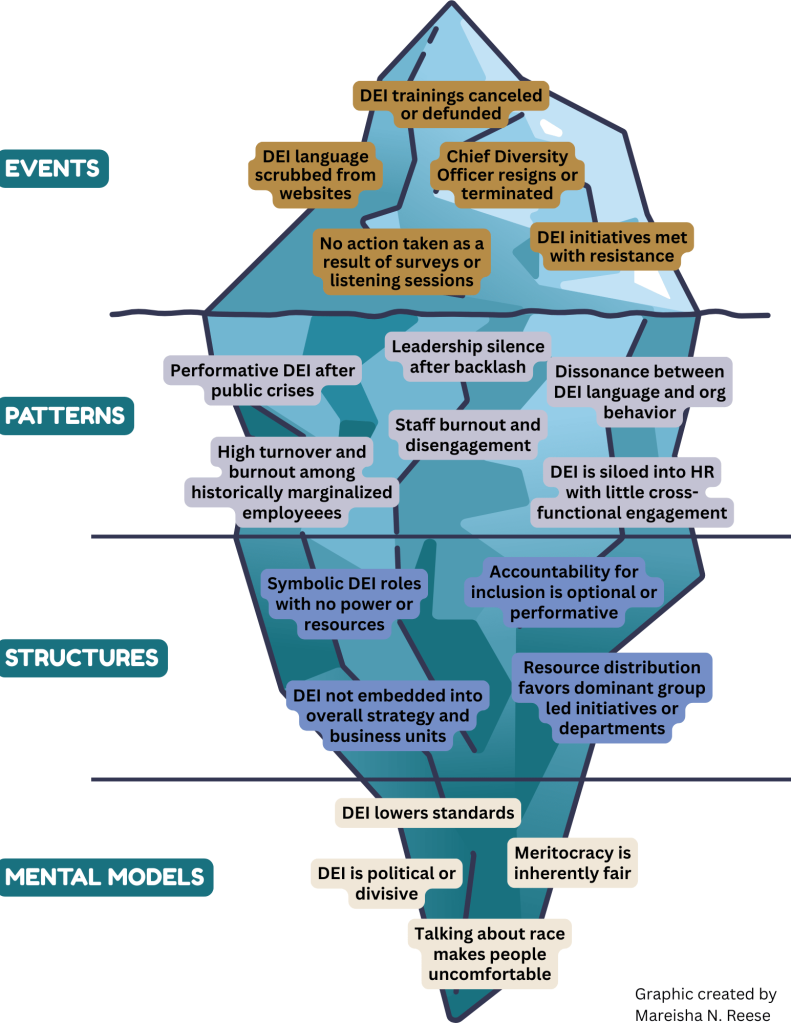
Beneath that lie structural barriers. This includes a lack of leader accountability, DEI roles that lack real influence, and inequitable resource allocation. This leads to work that is unsustainable.
And at the base of the iceberg are the mental models, those deeply embedded beliefs like “DEI lowers standards,” “talking about race is divisive,” or “we already treat everyone the same.” These assumptions may go unspoken, but they shape decisions every day. And unless we challenge them, no amount of strategy will stick.
Why This Feels So Hard Right Now
We’ve been living in a VUCA (volatile, uncertain, complex, and ambiguous) world. DEI work, by its nature, challenges the status quo. In times of instability, many leaders retreat in the name of playing it safe. Leaders are worried about legal risks, political pressure, or alienating donors or customers. Simultaneously, they may feel threatened by the deeper shifts DEI requires, like sharing power, challenging dominant norms, or changing how decisions are made. In these moments, retreating can feel like the easiest option. That retreat often gets framed as neutrality, but neutrality in the face of inequity isn’t neutral. It’s a choice to preserve comfort over change.
Companies walking away from DEI face real consequences. Organizations that lack meaningful DEI commitments or that deprioritize them often face decreased innovation, lower employee engagement, and, in some cases, brand trust. For example, Target’s decision to scale back its DEI efforts led to public backlash, a decline in sales, and a drop in stock value. It’s a stark reminder that retreating under pressure can come at a cost.
Five Ways to Disrupt DEI Resistance
If resistance is systemic, then change must be, too. That means moving beyond one-off initiatives or performative gestures and focusing instead on the deeper patterns, structures, and mental models that sustain inequity. In systems thinking, these are called leverage points—places where a small but strategic shift can create ripple effects throughout the whole system.
Here are five ways organizations can begin to disrupt resistance at the system level:
1. Challenge the Mental Models
Mental models are the deeply held beliefs that shape how people interpret the world and justify inaction. We need to challenge these and get honest about the stories we tell ourselves. Is neutrality really neutral? Is meritocracy truly fair? Storytelling, dialogue, and reflective practice can help surface and sift the assumptions that quietly drive decision-making.
2. Center Marginalized Voices in Decision-Making
In systems thinking, information flow is a powerful leverage point. Organizations must move beyond “gathering input” and redesign decision-making structures to include those most impacted by inequity. This could mean formalizing equity councils, building cross-functional advisory groups, or embedding equity-focused reviews into planning cycles. The goal is to change who has access to insight, influence, and authority.
3. Distribute the Responsibility
Equity work can’t live in one person’s job description or be one department’s responsibility. To shift the system, organizations must decentralize ownership and empower employee resource groups (ERGs), frontline teams, and mid-level leaders to act as co-stewards of culture change. That means providing resources, visibility, and real decision-making power. Shared responsibility strengthens credibility across the organization and makes equity efforts more likely to withstand change or resistance.
4. Integrate Equity Into Core Systems and Strategy
If DEI is seen as optional or “extra,” it will always be the first thing cut. Equity must be embedded into how goals are set, how performance is measured, and how decisions are made. This includes integrating equity into operational planning, budgeting, performance reviews, and strategy development and evaluation. When equity becomes part of the system’s design, it’s no longer optional, it’s foundational.
5. Lead for Complexity, Not Control
In complex systems, leadership isn’t about having all the answers, it’s about creating conditions for adaptation. Justice-centered leadership means sitting with discomfort, sharing power, and staying curious. It means moving from directing to enabling, from knowing to learning. And in moments of resistance, it means seeing tension not as failure, but as a sign that the system is shifting.
If your organization is feeling the tension around DEI right now, don’t mistake it as a reason to pause or, worse, to quit. That tension is a sign the system is being stretched. And in that discomfort, real transformation is possible. Resistance isn’t failure, it’s feedback. And systems, no matter how entrenched, can be changed.
So, what will you do? Will you retreat or reimagine? Will you perform or transform? Will you protect your comfort, or practice courage?
Resisting resistance means leading with courage when it’s easier to stay silent and remembering that inclusion isn’t a trend, it’s a commitment to shared humanity. It’s also about interrupting the system and designing a new one that can sustain equity, even when it’s hard.