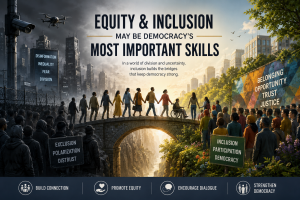
“The challenge before us is not simply to react, but to respond with intention. To hold the line on equity and inclusion even when it is uncomfortable. To strengthen social cohesion by … refusing narratives that pit communities against one another. And to remember that progress, especially in turbulent times, is shaped by the choices we make.”
It is the start of a new year. And what a year it has been so far! The turmoil caused by the current administration in the United States continues to disrupt and shake the foundations of the world.
From global markets to multilateral institutions, from public discourse to everyday community life, the ripple effects are being felt far beyond the U.S. Here in Canada, our very existence as a country is being challenged with external threats of making us the 51st state of the US, and, internally, separatist movements in Alberta and Quebec.
In speaking about the change in the world order, Prime Minister Mark Carney rightly calls it a “rupture” and not just a “transition”. Long-standing assumptions about stability, cooperation, and shared values are being tested. For many, this moment feels unsettling; marked by uncertainty, polarization, and rapid change.
One of the clearest signals of this shift has been the continued – and growing – backlash against diversity, equity, and inclusion work. Across sectors, DEI initiatives are being scaled back, reframed, abandoned altogether, and are often portrayed as expendable in times of political or economic pressure. The consequences of this retreat extend well beyond individual programs or roles; people have lost their jobs. When equity and inclusion are deprioritized, trust erodes, voices are marginalized, and the social fabric that holds diverse communities together begins to fray.
As I listened to Conservative Leader Pierre Poilievre bemoan the existence of “hyphenated” Canadians in his speech to delegates at the leadership convention, it reminded me of the divisive rhetoric we have been hearing from south of our border.
Poilievre argued for a vision of Canada in which people identify simply as Canadians, rather than with hyphenated identities such as Chinese-Canadian or Indian-Canadian. He said he wants a nation “with no more hyphens, no more group labels,” emphasizing the idea that when newcomers arrive, they should leave differences at the door and adopt a common Canadian identity.
This old, tired and lazy argument reflects a political stance against multicultural or group-specific identities, which Poilievre and his supporters often link to broader attacks against diversity, equity and inclusion (DEI) and what they call “woke ideology.” This argument can only lead to a weakening of social cohesion.
Social cohesion is not a given; it is built through deliberate effort. The pullback from DEI work risks deepening divides at precisely the moment when shared understanding, fairness, and belonging are most needed. Without intentional investment in equity and inclusion, polarization hardens, misinformation spreads more easily, and communities become less resilient in the face of change.
And yet, history reminds us that periods of disruption are also moments of possibility. Across communities, organizations, and movements, there are renewed efforts to defend democratic norms, reaffirm human dignity, and re-centre equity as essential to collective well-being.
As I witness what’s happening in places like Minneapolis, where residents are resisting the deadly actions of ICE agents, or the rising nationalism of Canadians against increasing American imperialism, I remain optimistic that people are asking harder questions about power and accountability, and re-imagining how leadership can show up with courage, humility, and care in an interconnected world.
Like most DEI practitioners, DiversiPro had a challenging 2025. But we were blessed to have worked with great clients like Oak Valley Health, a leading community health care organization and Destination BC, a provincial tourism agency, that continue to see the value in creating inclusive spaces for employees and their customers.
As we move further into the new year, the challenge before us is not simply to react, but to respond with intention. To hold the line on equity and inclusion even when it is uncomfortable. To strengthen social cohesion by listening deeply, acting collectively, and refusing narratives that pit communities against one another. And to remember that progress, especially in turbulent times, is shaped by the choices we make.
The year ahead will not be easy. But it can still be purposeful.